2025-26 Annual Report
The Commission’s annual report provides information about its activities and financial performance.
The Commission is required to complete its annual report by 30 September each year and provide it to the President of the Legislative Council and the Speaker of the House of Assembly. The President and Speaker are required to table the report on the first sitting day after having received it.
The report is published on the Commission’s website after it has been tabled in Parliament.
Annual Report 2025-26 PDF
Audited Financial Statements 2025-26
30 September 2026
The Hon. Kyam Maher MLC
Deputy Premier
Attorney-General
Parliament House
North Terrace
Adelaide SA 5000
The Hon. Nat Cook MP
Speaker of the House of Assembly
Parliament House
North Terrace
ADELAIDE SA 5000
The Hon. Reggie Martin MLC
President of the Legislative Council
Parliament House
North Terrace
ADELAIDE SA 5000
Pursuant to section 45 of the Independent Commission Against Corruption Act 2012 (SA) (ICAC Act) and section 12 of the Public Sector Act 2009 (SA) (PS Act), I present the Independent Commission Against Corruption’s Annual Report for the 2025-26 financial year.
This report meets the requirements of section 45 of the ICAC Act, section 12 of the PS Act and the Premier and Cabinet Circular PC013 Annual Reporting Requirements.
The report includes a link to information made available by the Commissioner of Police on the number and general nature of sanctions imposed under the Police Complaints and Discipline Act 2016 (SA), as required by section 31 of that Act.
Section 45(6) of the ICAC Act requires that the report be laid before the respective Houses on the first sitting day after it is received.
Cassie White
Acting Commissioner
Independent Commission Against Corruption
This annual report marks my first full year as Commissioner of the Independent Commission Against Corruption (ICAC), during which I have been privileged to oversee significant activity in preventing and responding to corruption in South Australia’s public administration.
The volume of matters being referred to ICAC remains high, with 155 referrals received from the Office for Public Integrity (OPI) during this reporting period. This is accompanied by a rise in the complexity and sensitivity of matters requiring investigation. As a result, ICAC's investigative workload continues to grow, with cases increasingly involving the use of a broader range of powers and investigative methods, and taking significant time to resolve. Addressing these matters effectively requires strong investigative expertise, alongside a steadfast commitment to treating all individuals who engage with ICAC with fairness, dignity, and respect.
Recognising this, an important focus over the past year has been ICAC’s witness support function. At the time of our previous annual report, this capability was still in its infancy. This year we have continued to develop our witness support resources, staff training and organisational approach, with a particular focus on supporting vulnerable people and embedding trauma-informed ways of working into our operations wherever possible.
A significant achievement this year was the completion of ICAC’s major project examining South Australia’s whistleblower protection framework. The project involved consultation on a discussion paper, two agency evaluations, and a highly successful public forum attended by more than 260 participants. The resulting report, Doing Right by Those Who Call Out the Wrong, contained 61 recommendations to strengthen the regime, including a key proposal to establish a dedicated whistleblower support service. The project reinforced the critical importance of supporting and protecting individuals who report wrongdoing and provided a valuable opportunity to consider how South Australia’s legislative approach to whistleblower protection can be enhanced.
My vision for ICAC as an approachable, fair and collaborative organisation continues to guide our education and engagement efforts, with more than 60 sessions delivered during the year. We have continued to strengthen our partnerships with colleagues at Ombudsman SA and the OPI, as well as with the broader public sector. One of my priorities has been regular engagement with executive leaders, recognising their critical role in setting the tone from the top. Effective leadership and a positive organisational culture are essential to creating workplaces where ethical behaviour is the norm, concerns can be raised safely, and employees feel empowered to speak up when something is not right.
From an organisational perspective, ICAC welcomed its new Deputy Commissioner, Cassie White, in May 2026. She brings fresh ideas and a deep understanding of the responsibilities of public authorities and the challenges they face. Important information management and technology projects are underway within ICAC to create a more modern and agile workplace, including introducing online collaborative tools, better remote working capability and a contemporary case management system.
Looking ahead, we will continue a focus on strengthening ethical decision-making frameworks and practices within public authorities. We will also work with agencies to help embed the lessons from the Whistleblower Project, particularly those recommendations and improvements that can be implemented without legislative change.
ICAC’s work is vital in maintaining public confidence in the integrity of South Australia’s public administration. I thank our staff for their professionalism, commitment and care throughout the year, and our colleagues across government and the integrity sector for their ongoing collaboration and commitment to continuous improvement. Together, we can support a public sector where integrity is actively championed, ethical decision-making is valued and people feel safe to speak up.
Emma Townsend
Commissioner
Independent Commission Against Corruption
What does ICAC do?
ICAC is established by the Independent Commission Against Corruption Act 2012 (ICAC Act). ICAC is an independent body and is responsible for investigating and preventing corruption in South Australian public administration. ICAC plays a vital role in the South Australian integrity landscape and seeks to serve the public by ensuring, and promoting, integrity in public administration.
ICAC receives referrals of potential corruption in public administration from the Office for Public Integrity (OPI). When a referral is received, it is either investigated by ICAC or referred to South Australia Police (SAPOL). If an investigation finds evidence to support an allegation of potentially corrupt conduct, ICAC will prepare a brief of evidence for SAPOL who will further investigate the matter and decide whether a prosecution should be commenced, including by way of a referral to the Office of the Director of Public Prosecutions (ODPP). ICAC does not make findings of corrupt conduct or impose sanctions or penalties.
As well as investigating potential corruption, ICAC has a prevention function which aims to prevent and minimise corruption within public administration. This is achieved through making recommendations to public authorities, conducting evaluations, making reports to Parliament, publishing education resources such as articles and providing education and training to public officers. These activities assist public authorities to understand, identify and respond to corruption risks.
ICAC also performs functions under the Police Complaints and Discipline Act 2016 (SA) (PCD Act), namely, conducting investigations of alleged breaches of discipline by police officers which arise from complaints or reports made under the PCD Act and referred to ICAC by the OPI. These referrals are usually made when the OPI considers there is a need for an authority independent of SAPOL to conduct the investigation. For example, when the allegations involve a senior member of SAPOL or a member of the Internal Investigation Section (being the section that usually undertakes investigations under the PCD Act).
Legislation administered by ICAC
ICAC administers the following legislation:
Independent Commission Against Corruption Act 2012
Functions and objectives
Section 7(1) of the ICAC Act sets out the functions of ICAC:
- There is to be an Independent Commission Against Corruption with the following functions:
- to identify corruption in public administration and to -
- investigate and refer it to a law enforcement agency for any further investigation and prosecution; or
- refer it to a law enforcement agency for investigation and prosecution;
- to evaluate the practices, policies and procedures of inquiry agencies and public authorities with a view to advancing comprehensive and effective systems for preventing or minimising corruption in public administration;
- to conduct or facilitate the conduct of educational programs designed to prevent or minimise corruption in public administration;
- if, in the course of performing functions in relation to potential corruption in public administration, any suspected misconduct or maladministration or any offences (not being offences that constitute the potential corruption in public administration) are identified—to report the matter to the Office or the Ombudsman for assessment or refer the matter to a law enforcement agency, the Ombudsman or a public authority or public officer, as the Commission considers appropriate.1
- to identify corruption in public administration and to -
1Reference to ‘the Office’ is the Office for Public Integrity.
Strategic focus
The ICAC Act defines ICAC’s objectives and functions, including to identify, investigate and prevent corruption in South Australian public administration. These legislative functions underpin ICAC’s strategic direction and guide its operational activities.
Alongside the delivery of its core legislative responsibilities during 2025-26, ICAC’s new leadership team prioritised a range of foundational activities to support the organisation’s long-term effectiveness and performance. Key to this was the development of a holistic Risk Management Framework, providing the groundwork for strong organisational governance and risk oversight. This work will be finalised in early 2026-27 and will inform the development of a new Strategic Plan that will establish ICAC’s strategic focus for the years ahead.
Vision
A State in which the community can be confident that public institutions maintain the highest standards of integrity.
Purpose
To serve the public interest by promoting integrity in public administration through the investigation of corruption and proactive prevention and educational initiatives.
Our values
Excellence
We lead by example and demonstrate best practice. We continually strive to improve our capabilities, skills and knowledge. We are curious, courageous, rigorous, and professional.
Independence
We conduct ourselves without fear or favour and make decisions according to law. We understand that we have a particular responsibility that is ours alone. We take our responsibilities seriously and use our powers carefully.
Respect
We treat everyone with respect.
Accountability
We use our resources responsibly. We scrutinise ourselves as vigorously as we scrutinise others.
Integrity
We are fair and unbiased in all our dealings. We are honest, trustworthy, reliable and fearless in fulfilling our duties.
Collaboration
We encourage the sharing of knowledge and ideas. We actively seek the perspectives and contribution of others. We work together to achieve best outcomes.
Our organisational structure
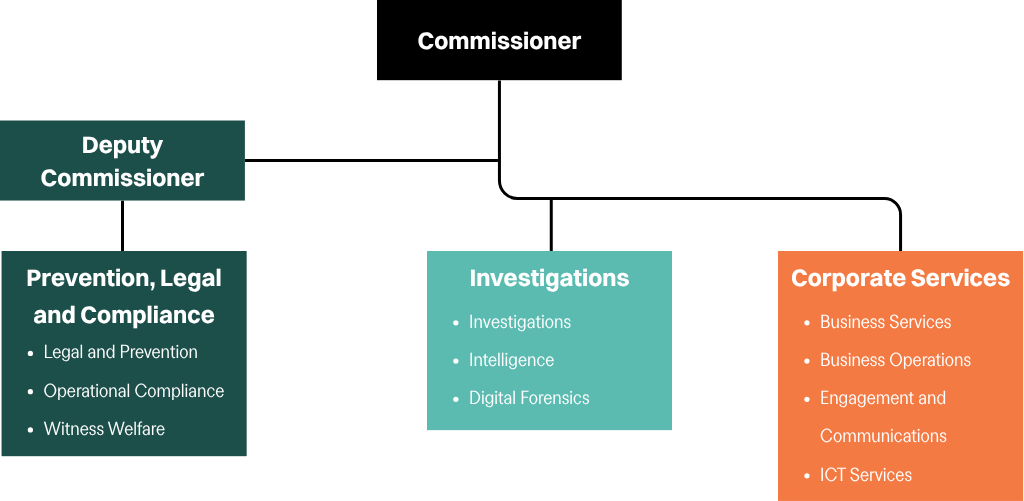
Changes to ICAC
The following structural changes occurred in 2025-26 within ICAC functional teams.
Witness Welfare Services
Acknowledging that witnesses (taken to include persons of interest in this context) may experience stress, emotional discomfort or other impacts on their wellbeing during an ICAC investigation or prevention activity, ICAC has employed a Witness Welfare Officer. It is the role of the Witness Welfare Officer to provide support to those witnesses and work with ICAC staff to design organisational practices and procedures that minimise the risk of adverse impacts to a witness’ psychological wellbeing.
The Witness Welfare Service commenced the provision of services late in the last financial year, with 23 witnesses receiving support during this financial year. Also during this period, an information booklet was produced for witnesses, a Witness Welfare Policy and Procedure was drafted and implemented, and plans were made to engage an external provider to provide targeted psychological assistance to witnesses who may benefit from additional support.
Legal and Prevention
In the latter part of the 2025-2026 financial year, ICAC undertook an organisational change initiative which centred on the amalgamation of the existing Legal and Prevention teams. These teams were previously established as two separate teams. The change proposal created two multi-disciplinary teams of both legal officers and prevention analysts, each reporting to a Manager of Legal and Prevention, who in turn reports to the Deputy Commissioner. The changes to this structure have been finalised in early 2026-27, with the advertising and appointment of two Managers Legal and Prevention.
The organisational change will promote the up-skilling of both legal officers and prevention analysts through working more closely together and sharing their respective skills, knowledge and experience.
ICAC's Executive Management Team
As at 30 June 2026
Commissioner
Emma Townsend
The Commissioner was appointed in accordance with section 8 of the ICAC Act. She is the Principal Officer of ICAC and is responsible for the functions outlined in the Act.
Deputy Commissioner
Cassie White (since May 2026)
The Deputy Commissioner was appointed in accordance with section 9 of the ICAC Act. She performs functions and exercises powers at the direction of the Commissioner and acts as Commissioner when the Commissioner is absent from, or unable to discharge, official duties. The Deputy Commissioner leads the Legal, Prevention, Compliance and Witness Welfare sections.
Director Investigations
Christine Baulderstone
The Director Investigations leads and manages the Investigations section and provides critical advice and recommendations on corruption investigations and other operational matters.
Director Corporate Services
Madelaine Turner
The Director Corporate Services leads and manages ICAC's corporate operations, including finance, human resources, information and technology management, procurement, policy development and facilities functions as well as records and data management, and risk and audit.
Performance at-a-glance
Leadership
- Welcomed Deputy Commissioner Cassie White in May 2026.
Investigations
- 72 corruption investigations were closed.
- 75% were completed within 9 months of determining to investigate.
- 58 new investigations commenced.
Prevention
- One evaluation.
- 11 prevention letters.
- 96 recommendations made to improve integrity in public authorities.
Whistleblower Project
- Released the major Whistleblower Project report: Doing right by those who call out the wrong.
- Hosted the highly successful Whistleblower Project public forum with over 260 attendees both online and in person.
Commissioned Artwork
- New Aboriginal artwork by Ngarrindjeri artist Jordan Lovegrove.
Witness Welfare
- Implemented a witness welfare function.
- 23 witnesses received support from ICAC's Witness Welfare Officer.
- Produced an information booklet for witnesses.
Education
- 62 education presentation and workshops delivered, including seven executive presentations.
- Over 2,000 attendees.
Investigations
One of ICAC’s primary functions is to identify and investigate corruption in public administration.
Corruption in public administration is defined in section 5 of the ICAC Act and includes conduct that constitutes:
- an offence against Part 7 Division 4 of the Criminal Law Consolidation Act 1935, which includes offences such as bribery of public officers, abuse of public office and offences relating to appointment to public office
- an offence against the Public Sector (Honesty and Accountability) Act 1995 or the Public Corporations Act 1993, or an attempt to commit such an offence
- an offence against the Lobbyists Act 2015, or an attempt to commit such an offence
- being complicit in, or conspiring with others to commit, an offence mentioned above.
A matter assessed by the OPI as raising a potential issue of corruption in public administration and referred to ICAC can be investigated by ICAC or referred to SAPOL or another law enforcement agency.2 ICAC may also conduct a joint investigation with a South Australian law enforcement agency.3
The OPI also refers to ICAC matters involving the conduct of SAPOL officers.4 The Commissioner determines whether such matters will be investigated under the PCD Act in relation to an alleged breach of discipline or the ICAC Act if the allegation raises a potential issue of corruption.5
Corruption investigations are, by definition, criminal investigations. The purpose of such an investigation is to collect evidence and, where appropriate, refer the matter to SAPOL or another law enforcement agency for further investigation and potential prosecution.
During the reporting period, ICAC received 155 referrals from the OPI under the ICAC and PCD Acts.6
Matters investigated by ICAC
| Act or Regulation | Requirement |
|---|---|
| Independent Commission Against Corruption Act 2012 | Section 45(4)(b)(i) The number and general nature of matters investigated by ICAC. |
Corruption investigations
The OPI refers to ICAC matters that are assessed as ‘raising a potential issue of corruption in public administration that could be the subject of a prosecution’.7 The OPI obtains the Commissioner’s views on a referral before formally referring a matter.8 The Commissioner determines whether ICAC will investigate the matter or refer it to SAPOL. During the reporting period ICAC commenced 58 new corruption investigations.
| General nature of investigations commenced | 2025-26 | 2024-25 |
|---|---|---|
| Corruption | 58 | 65 |
During the reporting period:
- Two joint investigations were commenced with another agency.
- ICAC continued 43 corruption investigations that began in previous reporting periods.9
- ICAC closed 72 investigations – out of those 68 were investigated under section 24 of the ICAC Act and four were investigated under section 30 of the PCD Act.
ICAC sets performance benchmarks for the timeframe within which it aims to complete an investigation. Prior to this reporting period, ICAC had a benchmark to complete 80% of all corruption investigations within nine months.
From 1 July 2025, ICAC has implemented more nuanced benchmarks, recognising that some investigations will take longer than nine months due to their complexity, significance, size or other factors.
- For matters assessed as being of ‘standard’ complexity, ICAC will aim to complete the investigation within nine months.
- For matters assessed as being ‘complex’ in nature, ICAC will aim to complete the investigation within 15 months. ICAC is yet to close any complex investigations under this benchmark.
In 2025-26, 72 matters were closed. This includes matters commenced in previous years as well as this reporting year.10 Of these, 54 investigations (or 75%) were closed within nine months.
Other investigations
During the reporting period, ICAC investigated five matters in accordance with section 30 of the PCD Act.
| General nature | 2025-26 | 2024-25 | Change (+/-) |
|---|---|---|---|
| Code of Conduct | 5 | 4 | 1 |
Matters referred for investigation to the Commissioner of Police or other law
enforcement agency
| Act or Regulation | Requirement |
|---|---|
| Independent Commission Against Corruption Act 2012 | Section 45(4)(b)(v) The number and general nature of matters referred for investigation to the Commissioner of Police or other law enforcement agency. |
Matters referred for investigation to SAPOL
During the reporting period, ICAC referred 97 matters to SAPOL for investigation.
| General nature | 2025-26 | 2024-25 | Change (+/-) |
|---|---|---|---|
| Corruption | 97 | 96 | 1 |
Warrants issued by ICAC and by judges of the Supreme Court
| Act or Regulation | Requirement |
|---|---|
| Independent Commission Against Corruption Act 2012 | Section 45(4)(b)(ii) The number of warrants issued by ICAC and by judges of the Supreme Court. |
Warrants authorising the entry and search of a vehicle or place can be issued by the Commissioner11 or a Judge of the Supreme Court.12 A warrant may be issued if the Commissioner or Judge is satisfied the warrant is reasonably required in the circumstances for the purposes of an investigation into a potential issue of corruption in public administration.
It is ICAC policy that in all but exceptional circumstances an application for a warrant under section 31 should be made to a Judge and not the Commissioner.
| Investigative powers | 2025-26 | 2024-25 | Change (+/-) |
|---|---|---|---|
| Search warrants issued by ICAC | 0 | 0 | 0 |
| Search warrants issued by a Judge of the Supreme Court | 7 | 28 | -21 |
| Total warrants | 7 | 28 | -21 |
Compared with the 2024-25 financial year, there was a decrease in the number of search warrants issued by a judge of the Supreme Court. This decrease was largely due to the nature of the investigations undertaken by ICAC during this reporting period.
Examinations conducted
| Act or Regulation | Requirement |
|---|---|
| Independent Commission Against Corruption Act 2012 | Section 45(4)(b)(iii) The number of examinations conducted. |
ICAC may conduct an examination for the purposes of an investigation into corruption in public administration.13 During the reporting period two examinations were conducted.
| Examinations | 2025-26 | 2024-25 | Change (+/-) |
|---|---|---|---|
| Examinations - ICAC | 2 | 2 | 2 |
Investigations which have resulted in prosecutions or disciplinary action
| Act or Regulation | Requirement |
|---|---|
| Independent Commission Against Corruption Act 2012 | Section 45(4)(b)(iv) The extent to which investigations have resulted in prosecutions or disciplinary action. |
ICAC cannot refer matters directly to the ODPP following a corruption investigation. Instead, where an investigation identifies evidence of corruption in public administration, ICAC must, where appropriate, refer the matter to SAPOL, or another law enforcement agency, for further investigation and potential prosecution.
Where ICAC determines not to refer a brief to SAPOL, or another law enforcement agency, the matter may be closed or referred to a public authority to deal with any potential misconduct or maladministration.
During the reporting period, ICAC referred three matters to SAPOL for further investigation and potential prosecution:
| Name | Brief referred to SAPOL | Status | |
|---|---|---|---|
| 2025/000004 – Z L | 29/08/2025 | Under review by SAPOL | |
| 2025/000419 – K F | 23/09/2025 | Under review by SAPOL | |
| 2025/000116 – R M | 29/06/2026 | Under review by SAPOL | |
During the reporting period, four individuals who were previously the subject of an ICAC corruption investigation and subsequent prosecution were sentenced by the Court.
| Name14 | Offence | Sentencing date | Sentence |
|---|---|---|---|
| PP and GJ (22/1381) | Abuse of public office | 31 July 2025 | PP was sentenced to 1 year 9 months imprisonment to be served on home detention. GJ was sentenced to 1 year 17 days imprisonment as a suspended sentence. |
| Bell, Troy | Theft and Dishonest dealings with documents | 21 October 2025 | TB was sentenced to 5 years imprisonment. |
| Robinson, Paul | Abuse of public office | 4 December 2025 | PR was sentenced to 4 years 5 months imprisonment. |
The following matters were investigated by ICAC, resulted in charges being laid by the ODPP or SAPOL and remain before the Court. The number and nature of the charges may change during proceedings.
| Name14 | Brief referred date | Arrest / summons date | Initial charges laid |
|---|---|---|---|
| Ellis, Fraser15 | 17 December 2020 (ODPP) | 17 February 2021 | 23 counts of deception |
| TB (21/345) | 26 August 2021 (SAPOL) | 14 December 2021 | 52 counts of deception |
| PB (24/102) | 14 April 2025 | 2 July 2025 | 78 counts of Abuse of Public Office |
| MO (25/136 & 25/323) | 28 May 2025 | 17 December 2025 | 3 counts of Abuse of Public Office |
Occasions on which public statements have been made by ICAC
| Act or Regulation | Requirement |
|---|---|
| Independent Commission Against Corruption Act 2012 | Section 45(4)(b)(vi) The number and general nature of occasions on which public statements have been made by ICAC. |
During the reporting period, ICAC issued five public statements.
Of these:
- two were about decisions to undertake evaluations - one regarding professional development funds for medical officers and one regarding how agencies receive and manage whistleblower reports
- one related to Commissioner Townsend announcing her prevention priorities for the subsequent six months
- one was about the outcome of an ICAC investigation of historical alleged breaches of discipline by the Commissioner of Police
- one was about an ICAC investigation into misconduct allegedly committed by a senior SAPOL officer.
Non-operational news and announcements are generally made via media release. ICAC issued seven media releases during the reporting period.
Matters referred to an inquiry agency or public authority
| Act or Regulation | Requirement |
|---|---|
| Independent Commission Against Corruption Act 2012 | Section 45(4)(b)(vii) The number and general nature of matters referred to an inquiry agency or public authority. |
Matters referred to an inquiry agency
Section 7(1)(d) of the ICAC Act provides, among other things, that ICAC can refer a matter to the Ombudsman. ICAC referred 10 matters to the Ombudsman in the reporting period.
Referrals to a public authority
Section 36 of the ICAC Act provides that ICAC can refer a matter to a public authority for further investigation and potential disciplinary action against a public officer for whom the authority is responsible.
During the reporting period, 11 matters were referred to a public authority.
| General nature of the matters referred to a public authority | 2025-26 | % | |
|---|---|---|---|
| Breach of departmental policy | 5 | 45% | |
| Failure to declare conflict of interest | 4 | 36% | |
| Abuse of power | 2 | 18% | |
| Total | 11 | 100% | |
Directions or guidance given in referring matters under the Act
| Act or Regulation | Requirement |
|---|---|
| Independent Commission Against Corruption Act 2012 | Section 45(4)(b)(viii) The number and general nature of directions or guidance given in referring matters under this Act. |
| Number and general nature of directions | 2025-26 | 2024-25 | |
|---|---|---|---|
| Report outcome | 3 | ||
| Undertake enquiries | 5 | ||
| Total | 8 | 0 | |
These eight directions were issued over three matters. There were a further eight matters that contained no directions.
Requests for examinations of accounts by the Auditor-General
| Act or Regulation | Requirement |
|---|---|
| Independent Commission Against Corruption Act 2012 | Section 45(4)(b)(ix) The number and general nature of requests for examinations of accounts by the Auditor-General. |
During the reporting period, ICAC made no requests for examinations of accounts by the Auditor-General.
Prevention
Recommendations made to an inquiry agency or public authority
| Act or Regulation | Requirement |
|---|---|
| Independent Commission Against Corruption Act 2012 | Section 45(4)(b)(x) The number and general nature of recommendations made to an inquiry agency or public authority by ICAC. |
During the reporting period, ICAC made 96 recommendations, including 61 general recommendations and 35 agency targeted recommendations.
Out of the 96 recommendations, 27 were outlined in 11 prevention letters to public sector agencies and councils, and 69 were made in two reports tabled in Parliament in accordance with sections 41 or 42 of the ICAC Act.
The recommendations made by ICAC fall into the following general categories:
| General nature category | Number of recommendations |
|---|---|
Authorisation of payments
| 1 |
Certification obligations
| 1 |
Complaint management
| 1 |
Conflicts of interests
| 6 |
Contract management
| 1 |
Grants administration
| 1 |
Human resources
| 2 |
Major infrastructure/capital works projects
| 1 |
Overtime/rostering
| 2 |
Procurement
| 2 |
Professional development funds
| 8 |
Public interest disclosures
| 61 |
Public officer status
| 1 |
Record keeping
| 1 |
Reporting obligations
| 1 |
Tier 3 vehicle inspections
| 2 |
Unsolicited proposals
| 2 |
Use of contractors to perform services that support the discharge of statutory,
| 1 |
Use of contractual arrangements to discharge external statutory or regulatory
| 1 |
Reports made to the Attorney-General, President of the Legislative Council or Speaker of the House of Assembly
| Act or Regulation | Requirement |
|---|---|
| Independent Commission Against Corruption Act 2012 | Section 45(4)(b)(xi) The number and general nature of reports made to the Attorney-General, President of the Legislative Council or Speaker of the House of Assembly. |
ICAC publishes reports about integrity issues identified in South Australian public administration. ICAC tabled reports are available on its website.16
Reports may include findings or recommendations arising from completed investigations as well as other matters identified through ICAC’s activities.
During the reporting period, ICAC provided the following two reports to the Attorney-General, the President of the Legislative Council and the Speaker of the House of Assembly, in accordance with section 40, 41 or 42 of the ICAC Act.
Integrity State 2024-2025
The report was tabled on 14 October 2025. It provides an overview of corruption prevention recommendations made to public authorities as a result of corruption investigations undertaken during the 2024-2025 financial year. Eight prevention letters were provided to public authorities during the last financial year.17 The letters set out 23 recommendations to help public sector agencies and councils implement and strengthen corruption prevention measures.
Doing right by those who call out the wrong: a review of South Australia’s whistleblower protection regime
The report was tabled on 25 June 2026. It examines the current whistleblower protection regime in South Australia. It makes 61 recommendations to enhance, simplify and strengthen South Australia’s current whistleblower scheme.
Activities carried out in relation to evaluation and educational functions
| Act or Regulation | Requirement |
|---|---|
| Independent Commission Against Corruption Act 2012 | Section 45(4)(b)(xii) A description of the activities carried out in relation to its evaluation and educational functions. |
Evaluations
ICAC may evaluate the practices, policies and procedures of inquiry agencies and public authorities with a view to advancing comprehensive and effective systems for preventing or minimising corruption in public administration.
During the reporting period ICAC completed one evaluation.
Evaluation of Professional Development Funds for Medical Officers
The Evaluation of Professional Development Funds for Medical Officers examined the practices, policies and procedures of the Department for Health and Wellbeing, SALHN and WCHN. The evaluation report was tabled in Parliament on 2 June 2026.
ICAC made eight recommendations to assist the Department, and local health networks to better manage the corruption risks associated with professional development funds for medical officers. These recommendations detail improvements to policies, practices and systems.
In addition, ICAC commenced two evaluations during the reporting period as part of its major Whistleblower Project, focussing on SAPOL and the Department of Human Services. These evaluations are now complete, but were still underway during the reporting period.
Education
ICAC leads and delivers an education program aimed at assisting public authorities and public officers to prevent or minimise corruption in public administration.
Online learning, video resources, and advisories are made available to help public officers and the community better understand corruption risks and integrity measures.
Presentations, seminars and workshops
ICAC's presentations and workshops reach a diverse range of participants from executives to front line staff, contractors and police cadets. 62 education sessions were delivered by way of presentations and workshops to more than 2,000 attendees from public administration. This includes:
- two full-day internal investigations workshops, which support public officers to conduct thorough and fair internal investigations
- four half-day responsible officer training sessions, which is a compulsory course for all responsible officers appointed under the Public Interest Disclosure Act 2018 (SA)
- 18 industry-specific training sessions, some of which were delivered with a theme such as procurement or ethical decision-making
- 24 ICAC general awareness sessions, providing an overview of the integrity landscape in South Australia, reporting obligations for public officers and information about making a report
- 14 other education sessions, such as public forums or webinars.
A further 34 education and prevention initiatives were delivered including survey reports, prevention letters, newsletters, education campaigns, and a discussion paper.
| Education sessions | 2025-26 | 2024-25 | Change (+/-) |
|---|---|---|---|
| Education sessions delivered | 62 | 67 | -5 |
| Attendees | 2,074 | 1,250 | +824 |
Online education programs
During the reporting period, ICAC offered three online education programs that had 2,749 enrolments:18
- ICAC's online education programs
- Introduction to Conflicts of Interest
- Internal Investigations - Concepts and Principles
- Preserving Integrity in Public Administration
Education resources
It is a primary function of ICAC to prevent and minimise corruption by assisting public authorities to understand, identify and respond to corruption risks. ICAC makes resources available to assist public officers and members of the community to fulfil this function. Those resources are published on the ICAC website.
During the reporting period, ICAC published:
- Tool and Guide: Integrity Maturity Self-Assessment
- Integrity Spotlight: Reducing the impact of gambling harm
- Integrity Essentials: Preventing the misuse of leave entitlements
- Integrity Essentials: What does corruption look like?
- Campaign: Corruption looks like…
Prevention letters
ICAC advises public authorities of the lessons emerging from completed investigations and opportunities to minimise and prevent corruption.
This generally takes the form of a prevention letter to the public authority. These outline observations by ICAC and contain recommendations to improve the agency’s practices, policies, procedures and training initiatives.
During the reporting period, the Commissioner sent 11 prevention letters to public authorities.19
- Nine to state government departments or statutory authorities
- Two to local councils
Public authorities are receptive to such correspondence. ICAC engages in a formal consultation process under which public authorities are given an opportunity to comment on proposed recommendations before they are formally issued by ICAC.
This ensures that the recommendations are practical, reasonable and proportionate in the circumstances and allows the agency to provide any additional information that ICAC may not have been aware of when considering whether recommendations should be made and, if so, the nature and scope of those recommendations.
Communication and engagement
The Commissioner, Deputy Commissioner and ICAC's employees make themselves available to engage with stakeholders where possible and appropriate. This may extend to guest speaker roles at various board meetings, forums and conferences.
ICAC uses various engagement channels to communicate with public officers and the community, with its website being the most widely used.
Section 48(1) of the ICAC Act describes the material that must be available on ICAC's website, including:
- information about educational programs conducted or facilitated by ICAC
- information about ICAC's evaluations
- information about the other functions of ICAC
- ICAC’s standard operating procedures
- reports prepared under sections 41 and 42 of the ICAC Act
- ICAC’s annual reports
- information designed to assist in preventing or minimising corruption. The material required by section 48(1) is available on ICAC’s website.
The material required by section 48(1) is available on ICAC’s website.
Any other matters stipulated by the regulations
Act or Regulation | Requirement |
|---|---|
Independent Commission Against Corruption Act 2012 | Section 45(4)(c) |
There are no matters to report.
Corporate
Workforce
The table below provides the total number of employees as at 30 June for each of the financial years listed. It is noted that the number of employees as at 30 June is not representative of the average number of employees over a year. As at 30 June 2026, ICAC has several vacancies, four of which are in the process of being filled at the time of writing with a further two to be advertised shortly thereafter.
Total number of employees (as at June 30) * | 2025-26 | 2024-25 | Change (+ / -) |
|---|---|---|---|
Persons | 55 | 63 | -8 |
Full Time Equivalent (FTEs) | 50 | 57.20 | -7.2 |
*While the Commissioner and Deputy Commissioner have been included in the above table, they are not employees of ICAC.
Separations and recruitment
Separations and recruitments continued to be a significant activity throughout the reporting period.
Number of persons | 2025-26 | 2024-25 | Change from last year (+ / -) |
|---|---|---|---|
Recruited to the agency | 13 | 31 | -18 |
Separated from the agency | 21 | 22 | -1 |
Employee turnover
Employee turnover has decreased slightly during the reporting period compared with the previous period. ICAC continues to attract and retain talented and knowledgeable employees. A significant amount of recruitment has taken place in the second half of the financial year and the number of applications received indicate that ICAC remains an attractive employment option for candidates with high levels of skill and experience.
Employee turnover | 2025-26 | 2024-25 | Change from last year (+ / -) |
|---|---|---|---|
Persons | 35.6% | 37.6% | -2% |
Leave management
In comparison to 2024-26, employee sick leave levels have decreased in 2025-26. Family carer’s leave has remained steady and special leave with pay has increased marginally.
Leave type (average days per FTE) | 2025-26 | 2024-25 | Change from last year (+ / -) |
|---|---|---|---|
Sick leave per FTE | 5.1 | 6.6 | -1.5 |
Family leave per FTE | 1.1 | 1.1 | - |
Special leave with pay per FTE | 0.8 | 0.6 | +0.2 |
Diversity and inclusion
During the reporting period, ICAC developed and finalised its Disability Access and Inclusion Plan (DAIP) 2026-29, for publication on its website in early 2026 27. This is in accordance with the SA Government State Disability Inclusion Plan which ensures that government services and programs are accessible and inclusive for people with disability. The actions arising from the DAIP plan will be implemented, monitored and reported to the Department of Human Services on an annual basis.
ICAC’s Diversity and Inclusion Committee, established to progress the agency’s commitment to diversity and inclusion, has worked to ensure that ICAC continues to provide awareness and promotion of diversity and inclusion initiatives throughout the year including the following:
- NAIDOC day observance was celebrated with all staff at a morning tea on 10 July 2025.
- An Aboriginal cultural awareness session for all staff facilitated by Kuma Kaaru on 18 November 2025.
Aboriginal artwork
During the reporting period, ICAC was proud to commission a new Aboriginal artwork by Ngarrindjeri artist Jordan Lovegrove. The artwork represents the role of ICAC in supporting integrity, transparency and accountability across public administration in South Australia.

At the base of the work sits a colourful and detailed meeting place representing ICAC as a small agency with broad impact. While modest in size, it plays an important role in guiding and supporting the wider system of public authorities and public officers, represented by the larger meeting places connected throughout the artwork. The pathways linking these meeting places represent the relationships, dialogue and shared responsibilities that exist across the public sector and local government.
From ICAC, a light extends across part of the landscape, shown through a shift in pattern and colour.
Rather than exposing or blaming, this light represents clarity, transparency and guidance, helping complex situations become clearer and supporting ethical decision-making. The flowing pathways form an ongoing cycle, reflecting ICAC’s dual roles – looking backwards to investigate potential corruption, and looking forwards to strengthen systems – both of which serve to ensure public resources are used for the benefit of the South Australian community.
Employment opportunity programs
ICAC is committed to fair, transparent and consistent recruitment practices that reflect public sector values and supports an inclusive, capable and high-performing workforce.
Program name | Performance |
|---|---|
Employment opportunity programs | ICAC does not currently utilise any specific employment opportunity programs for recruitment of new staff. |
Performance management and development systems
Performance management and development system | Performance | Completion rate * |
|---|---|---|
Performance management program | Jul - Dec 2025 | The completion rate (as a percentage) of ICAC’s staff participating in performance management program | 56% |
Performance management program | Jan - June 2026 | The completion rate (as a percentage) of ICAC’s staff participating in performance management program | 87% |
Training and development | 0.65 % of total salary expenditure was committed to providing staff training and development programs through ICAC’s Learning and Development Committee, Diversity and Inclusion Committee and Work Health and Safety Committee. | |
Work health, safety and return to work programs
Program name | Performance |
|---|---|
Work health and safety/return to work programs | During the reporting period, there were no workplace injury claims or Return to Work programs implemented. |
Employee Assistance Program | The Employee Assistance Program (EAP) continues to support employees and their immediate families with informal and confidential short term counselling advice and services, as well as support for managers through the Manager Assist program. During the 2025-26 financial year, a procurement process was undertaken and finalised for ICAC EAP services. |
Program name | Performance |
|---|---|
Wellbeing and safety at work | During 2025-26, ICAC conducted the People at Work Survey (PAWS) for all staff to identify psychosocial risks presenting within the ICAC worksite. 60% of staff responded to the survey, conducted in April 2026. A staff presentation of the results and the publishing of the Survey results to staff took place on 9 June 2026. In early 2026-27, staff workshops are planned for further discussion of recommended actions for mitigating identified psychosocial risks. |
Workplace injury claims | 2025-26 | 2024-25 | Change (+ / -) |
|---|---|---|---|
Total new workplace injury claims | 0 | 0 | - |
Fatalities | 0 | 0 | - |
Seriously injured workers* | 0 | 0 | - |
Significant injuries (where lost time exceeds a working week, expressed as frequency rate per 1000 FTE) | 0 | 0 | - |
*Number of claimants assessed during the reporting period as having a whole person impairment of 30% or more under the Return to Work Act 2014 (Part 2 Division 5).
Work health and safety regulations | 2025-26 | 2024-25 | % Change |
|---|---|---|---|
Number of notifiable incidents (Work Health and Safety Act 2012, Part 3) | 0 | 0 | - |
Number of provisional improvement, improvement and prohibition notices (Work Health and Safety Act 2012 sections 90, 191 and 195) | 0 | 0 | - |
Return to work costs* | 2025-26 | 2024-25 | % Change |
|---|---|---|---|
Total gross workers compensation expenditure ($) | 0 | 0 | - |
Income support payments – gross ($) | 0 | 0 | - |
*Before third-party recovery.
Executive employment in ICAC
Executive classification | Number of executives at 30 June 2026 |
|---|---|
Statutory appointments | 2 |
SAES1 | 2 |
The Office of the Commissioner for Public Sector Employment (external site) website provides further information on the breakdown of executive gender, salary and tenure by agency.
2 Independent Commission Against Corruption Act 2012 (SA) s 24 ('ICAC Act').
3 Ibid s 34(1).
4 Police Complaints and Discipline Act 2016 (SA) s 29.
5 Ibid s 30.
6 This number will differ slightly from what is reported by the OPI due to some cross-referenced matters being registered as a single matter by ICAC.
7 ICAC Act (n 2) s 18F.
8 Ibid s 18G.
9 In 2024-25 this number was 24. The significant increase in continued investigations this financial year reflects the growth in the number of investigations commenced in 2024-25.
10 This complexity assessment process was only applied to new matters from 1 July 2025. All matters carried over from previous financial years have not undergone the complexity assessment, and as such fall under the previous benchmark of nine months.
11 The Commissioner may only issue warrants authorising entry and search of places occupied or used by an inquiry agency,
public authority or public officer and vehicles owned or used by an inquiry agency, public authority or public officer.
12 ICAC Act (n 2) s 31.
13 Ibid s 29.
14 The amendments to the ICAC Act (n 2) which came into operation in October 2021 restrict the ability of ICAC to identify those who have been the subject of investigation. ICAC will not name individuals it has investigated if those individuals had charges laid against them after the amendments and those charges have not been finalised.
15 Mr Ellis has since been sentenced, but remained before the Court at the end of the reporting period.
16 'Independent Commission Against Corruption South Australia', Publications (Web Page) <https://www.icac.sa.gov.au/publications/all-reports>.
17 One letter was omitted in the report as it contained no recommendations.
18 This figure represents total course enrolments in 2025-26. Individuals enrolled in multiple courses are counted once for each course. ICAC's 2024–25 Annual Report reported total online course enrolments as 2,026. However, the total course enrolments for 2024–25 was 3,685, calculated using the same counting methodology described above, whereby individuals enrolled in multiple courses are counted once for each course.
19 The prevention letters will be summarised in ICAC’s annual Integrity State report– those letters include recommendations sent
to public authorities in 2024-25.
Financial performance at a glance
The following is a brief summary of the overall financial position of ICAC. The information is unaudited. Full audited financial statements for 2025-26 are attached to the PDF of the Annual Report in the Appendix.
Statement of comprehensive income | 2025-26 | 2025-26 | Variation | Past year 2024-25 Actual |
|---|---|---|---|---|
Total income | 12,568 | 13,500 | 932 | 11,940 |
Total expenses | 13,771 | 13,858 | 87 | 13,294 |
Net result | (1,203) | (358) | 845 | (1,354) |
Total comprehensive result | (1,203) | (358) | 845 | (1,354) |
Statement of financial position | 2025-26 Budget | 2025-26 Actual | Variation | Past year 2024-25 Actual |
|---|---|---|---|---|
Current assets | 9,488 | 10,566 | 1,078 | 11,477 |
Non-current assets | 1,876 | 2,053 | 177 | 1,090 |
Total assets | 11,364 | 12,619 | 1,255 | 12,567 |
Current liabilities | 872 | 926 | 54 | 872 |
Non-current liabilities | 1,087 | 1,442 | 355 | 1,086 |
Total liabilities | 1,959 | 2,368 | 409 | 1,958 |
Net assets | 9,405 | 10,251 | 846 | 10,609 |
Equity | 9,405 | 10,251 | 846 | 10,609 |
Consultants disclosure
The following is a summary of external consultants engaged during the reporting period by the agency, the nature of work undertaken, and the payments made for the work.
Consultancies with a contract value below $10,000
Consultancy | Purpose | $ Actual payment |
|---|---|---|
CyberCX Pty Ltd | Cyber security framework | $2,465.90 |
Total | $2,465.90 |
Consultancies with a contract value above $10,000
Consultancy | Purpose | $ Actual payment |
|---|---|---|
Faire Creative | Marketing | $12,465.35 |
CyberCX Pty Ltd | SaaS Risk Assessments | $20,000.00 |
Total | $32,465.35 |
See also the Consolidated Financial Report of the Department of Treasury and Finance (external site) for total value of consultancy contracts across the South Australian Public Sector.
Contractors disclosure
The following is a summary of external contractors engaged during the reporting period by the agency, the nature of work undertaken, and the payments made for the work undertaken.
Contractors with a contract value below $10,000
Contractors | Purpose | $ Actual payment |
|---|---|---|
Kim C Consulting Pty Ltd | Risk assessment management | $9,900.00 |
Madfox Design | Report design & typesetting | $9,000.00 |
CyberCX Pty Ltd | SACSF Attestation Support Services | $4,960.00 |
Liquid Pacific Holdings Pty Ltd | Valuation services | $3,875.00 |
MPH Architects | Concepts/scoping | $3,020.00 |
Adaptive Psychology | Human resources management | $1,800.00 |
Faire Creative | Graphic design services | $405.00 |
Total | $32,960.00 |
Contractors with a contract value above $10,000
Contractors | Purpose | $ Actual payment |
|---|---|---|
Hays Pty Ltd | Temporary Senior HR Business Partner | $34,002.15 |
Robert Walters Pty Ltd | Temporary Financial consultant | $17,520.88 |
Total | $51,523.03 |
The details of South Australian Government awarded contracts for goods, services, and works are available on the SA Tenders and Contracts website. View the agency list of contracts. (external site) The website also provides details of across government contracts. (external site)
Contracts entered with SA businesses and non-SA businesses
Contracts entered: | 2025-26 | 2025-26 |
|---|---|---|
with South Australian businesses | 1 | $4,440 |
with non-South Australian businesses | 1 | $3,506 |
Total | $7,946 |
Legal services disclosure
The following is a summary of external legal services engaged by the agency during the reporting period, the nature of work undertaken, and the payments made for the work undertaken.
Legal services with a contract value below $10,000
Legal services | Purpose | $ Actual payment |
|---|---|---|
Crown Solicitor's Office | SaaS Agreement | $8,730.90 |
Crown Solicitor's Office | Accession Deed | $3,498.90 |
Crown Solicitor's Office | Statutory interpretation | $2,452.50 |
Crown Solicitor's Office | Human resources advice | $2,190.90 |
Crown Solicitor's Office | Statutory interpretation | $1,589.50 |
Crown Solicitor's Office | Human resources advice | $588.60 |
Barrister fees | Corruption investigation | $243.60 |
Total | $19,294.90 |
Legal services with a contract value above $10,000
Legal services | Purpose | $ Actual payment |
|---|---|---|
Barrister fees | Corruption investigation | $25,000.00 |
Barrister fees | Corruption investigation | $22,117.48 |
Crown Solicitor's Office | Statutory interpretation | $10,583.50 |
Barrister fees | Corruption investigation | $10,396.00 |
Total | $68,096.98 |
Risk and audit at a glance
Audit and Risk Management Committee
ICAC's independent Audit and Risk Management Committee was established in May 2024 and met quarterly during the reporting period. (August, November, February and May).
The Committee supports ICAC by independently overseeing ICAC’s corporate functions from a financial, risk and security perspective. The Committee provides assurance to the Commissioner on the adequacy, effectiveness and appropriateness of ICAC in these functions.
Risk Management Framework
During the reporting period, ICAC Executive undertook a significant development program to refresh its risk management approach, focussing on Enterprise Risk identification and assessment, targeted risk and control matrices, Strategy Setting Risks and the development of Risk Appetite Statements, culminating in an updated Risk Management Framework that will be finalised in early 2026-27.
Protective Security
In July 2025 ICAC reported to the SA Government via an annual Attestation process on its approach to protective security for the previous financial year (2024-25) in line with the South Australian Protective Security Framework. During the reporting period, work progressed focused on maintaining compliance, addressing identified risks, and implementing measures to support the ongoing safety and security of people, information and assets.
Cyber Security
In a similar vein to Protective Security, ICAC provided Attestation reporting in July 2025 to SA Government with regards to its activities and treatments of cyber security risks during 2024-25, and throughout the reporting year, continued to work to maintain the highest level of protection for critical information and infrastructure that supports ICAC's operations.
Fraud detected in ICAC
There were no instances of fraud detected in ICAC in the reporting period.
Strategies implemented to control and prevent fraud
ICAC’s Internal Corruption Control Policy is reviewed annually. It provides a framework to minimise opportunities for corruption within the organisation and to maximise the potential for such conduct to be detected. It is an integral part of ICAC’s risk management system.
The Internal Corruption Control Policy captures conduct that extends beyond fraud and corruption to conduct that involves misconduct or maladministration in public administration.
ICAC has undertaken an internal corruption risk assessment as part of its internal corruption control plan. The risk assessment included risks related to financial management, and details controls that are in place to mitigate those risks.
Other controls that aim to control and prevent fraud include centralised management of procurement, contract management plans for complex and high value agreements and an annual financial management compliance program.
Public interest disclosure
Number of occasions on which public interest information has been disclosed to a responsible officer of ICAC under the PublicInterestDisclosureAct2018: none.
Sanctions under section 26 in relation to breaches of discipline
Act or Regulation | Requirement |
|---|---|
Police Complaints and Discipline Act 2016 | Section 31(1) |
ICAC is required to report on the number and general nature of sanctions imposed on designated officers under that Act. ICAC does not have any role in making findings in relation to a breach of discipline by a designated officer or in the sanctions imposed. In most cases, ICAC has no knowledge of the matters reported under section 26 of that Act.
These sanctions are imposed by the Commissioner of Police and are publicly available on the SAPOL website: SAPOL - Disciplinary outcomes. (external site)
Reporting requirements under the Carers Recognition Act 2005
ICAC currently does not have any compliance or reporting obligation under this Act.
Reporting requirements under the Climate Change and Greenhouse Emission Act 2007
The building owner of ICAC premises has identified and implemented initiatives during 2025-26 to reduce the impact of its building on climate change and on the community. The owner currently purchases the majority of its electricity from renewable sources and has recently submitted the building for re-assessment of its NABERS rating.
In addition to these actions of the owner, ICAC staff have participated in a number of programs initiated by the owner that focus on recycling and waste management.
Schedule 4 of the ICAC Act provides for the appointment of an Inspector who is responsible for an annual review examining the operations of ICAC. The Inspector also conducts reviews of matters arising from relevant complaints, and other reviews as contemplated by the Schedule.
In the case of an annual review examining the operations of ICAC, the Inspector is required to deliver a report to the President of the Legislative Council and the Speaker of the House of Assembly on or before 30 September in the following financial year. In any other case, the Inspector is required to deliver a report to the President of the Legislative Council and the Speaker of the House of Assembly as soon as practicable after completion of the review.
To facilitate the work of the Office of the Inspector, access to ICAC’s records is provided as required.
Any person can make a relevant complaint to the Inspector. A ‘relevant complaint’ is defined in Schedule 4 of the ICAC Act to be:
A complaint made in accordance with any requirements prescribed by the regulations relating to the conduct of any person exercising or purporting to exercise functions and powers under this Act.
Number of public complaints reported
The Commissioner and employees of ICAC are subject to external review by the Inspector. The number of complaints received will be reported by the Inspector. Where a complaint is made to the Inspector, ICAC cooperates with and provides relevant information to the Inspector to assist the Inspector to respond to the complaint or enquiry.
Please refer to the Annual Reports | Office of the Inspector (external site) for details of complaints made about ICAC.
Other accountability mechanisms
The operations of ICAC and the ICAC Act are subject to review by the Parliamentary Crime and Public Integrity Policy Committee. Other legislation provides for supervision of different aspects of ICAC’s operations by the Commonwealth Ombudsman, the Commonwealth Department of Home Affairs, the South Australian Attorney-General and the Auditor-General.
ICAC is committed to ensuring it meets its compliance responsibilities. This has included the creation of a dedicated operational compliance section.
All data relating to the previous year is publicly available on the DATA SA website (external site) for reference and comparison.
Full audited financial statements for 2025-26 are attached to this report.