
Witness information and support
Being involved as a witness in an Independent Commission Against Corruption (ICAC) investigation can be stressful.
ICAC employs a Witness Welfare Officer to help witnesses involved in its investigations to access support. For the purposes of providing such assistance, ICAC considers a witness to be:
- A person whose conduct is the subject of the allegations being investigated
- Someone who has provided information to the investigation (including in an interview or affidavit)
- A person who is otherwise impacted by ICAC’s functions and powers.
For information on the ICAC investigation process, and how you can access information and support, download the Information for witnesses brochure.
Witness Welfare Officer
ICAC’s Witness Welfare Officer (WWO) is a consistent point of contact during an investigation, offering:
- Information about ICAC processes and what to expect during an investigation
- Support at an interview or hearing
- Referrals to community-based support services or employee assistance providers where appropriate.
The ICAC WWO can be contacted at witnesssupport@icac.sa.gov.au or (08) 8463 5191.
Further personal and legal support services
- Registered health providers
General practitioner (GP)
Workplace employee assistance program
Psychologist or psychiatrist
- Crisis support services
If it is an emergency, please call 000
Mental Health Triage Services - 13 14 65
For assistance in a mental health emergency, available 24 hours a day, seven days a week, statewide in South Australia
13Yarn - 13 92 76
Aboriginal and Torres Strait Islander Crisis Support Line
Suicide Callback Service - 1300 659 467
Free professional phone counselling for people living in Australia
- Legal information and support
Legal Services Commission. Free Legal Helpline - 1300 366 424. Available for preliminary information, general advice and referrals. Advice is usually restricted to basic legal rights and obligations.
The Legal Services Commission Helpline is available weekdays, between 9:00am – 4:30pm (excluding public holidays).
Q&As about being involved in an ICAC investigation
No, you do not have to speak with ICAC officers unless you are served with a Notice or Summons. If that happens, you will be provided with further information about what you are required to do.
You are entitled to obtain legal advice about speaking with ICAC and to have a lawyer with you when you do.
How long an investigation takes varies greatly and depends on the size and complexity of the matter being investigated, the number of people involved, and the amount and type of evidence gathered.
If the matter is referred by ICAC to South Australia Police or a public authority for them to consider criminal or disciplinary proceedings, that agency will also take time to consider the material to determine and undertake the appropriate course of action.
You can seek an update about the progress of any investigation you have been involved in by contacting the investigator you dealt with or ICAC’s Witness Welfare Officer.
Flowchart: Process of an ICAC investigation
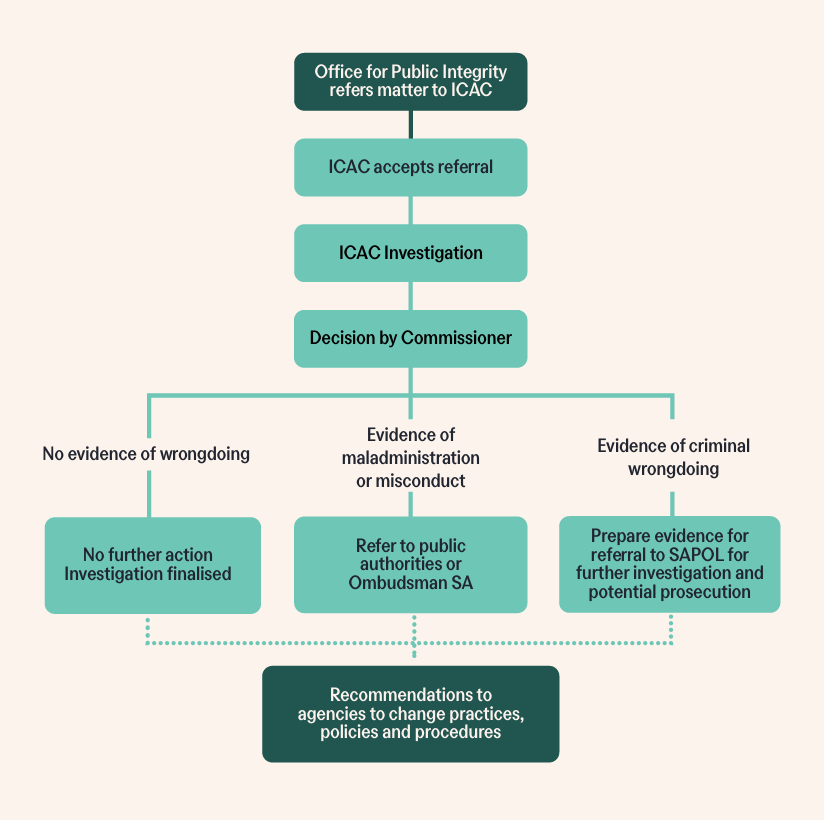
All ICAC investigations are strictly confidential. Section 54 of the ICAC Act imposes strict limits on how information that is connected with, or relates to, an investigation can be disclosed.
These restrictions apply to anyone who has knowledge of the investigation, including a witness. Failing to comply with these restrictions is a criminal offence, punishable by a fine of up to $2500 or six months’ imprisonment.
Information about an investigation cannot be disclosed unless it meets one of the exceptions in section 54 (3) of the ICAC Act.
These exceptions include:
- Disclosing information for the purposes of the investigation (for example, to an investigator)
- Obtaining medical or psychological assistance from:
- The Witness Welfare Officer
- A medical practitioner (GP, psychiatrist, specialist)
- A psychologist (private psychologist or Employee Assistance Program)
- Obtaining legal advice or legal representation for the purpose of determining whether there is an entitlement to indemnity for legal costs
- Advising your employer
- If the information relates to you, you may also disclose it to a close family member (including your spouse, parent, grandparent, sibling/s and children).
If you are uncertain about who you can speak to about an investigation, including to obtain support, you can speak to the investigator.
A person who receives information from you will also be subject to the restrictions in section 54 (3).